DON’T Eat Another Carbohydrate Until You Read Our Short Article Below!
Hey, this is Joel… co-founder of BioTrust Nutrition… and today I’m
here to talk to you about how a synergistic blend of 5 unique,
hard-to-come-by ingredients can dramatically enhance control of your
blood sugar levels while making carbohydrates–yes, carbohydrates–your body transformation’s best friend.
Now, you’ve probably heard that carbohydrates are perhaps the WORST
thing you could eat when trying to lose fat or transform your body, and
for most people, that’s 100% true.
 You see, due to years of consuming a diet full of processed carbs, most people have grown quite insensitive
to one of the most important hormones in our body—a hormone that can
either be a huge asset to your body transformation goals, or a total fat
loss and health-derailing nightmare.
You see, due to years of consuming a diet full of processed carbs, most people have grown quite insensitive
to one of the most important hormones in our body—a hormone that can
either be a huge asset to your body transformation goals, or a total fat
loss and health-derailing nightmare.
Its name is insulin.
And insulin’s function is to help your body keep blood sugar at bay,
clear it quickly from your bloodstream after a carbohydrate meal, and
(hopefully) shuttle that blood sugar to muscle tissue for energy instead
of fat.
I say “hopefully” because that’s actually the exact opposite
of what occurs when most people eat carbs. Going back to insulin
sensitivity and carbohydrate tolerance, due to a diet full of processed,
insulin–and blood–sugar-spiking carbohydrates, most folks are suffering
from some level of insulin resistance, a condition in which insulin is no longer able to efficiently remove blood sugar from the blood stream.
The result? Dramatically reduced fat burning
and increased fat storage.
Even worse, insulin resistance can and often does lead to type II
diabetes and an array of other health problems over time, and it all
leads back to insulin sensitivity.
Ideally, when you consume carbohydrates, here is what you want to happen:
1. Minimum insulin release. This occurs when your body is highly sensitive
to insulin. When it is, only a small amount of insulin is necessary to
effectively and efficiently clear glucose from your blood to its storage
sites. This is great news because your body has an incredibly difficult time burning fat in the presence of insulin. The less insulin you have floating around, the better.
2. Quick and efficient blood sugar clearance. Again, this will occur when your body is highly sensitive to insulin.
3. Maximum glycogen uptake. Glycogen is the term
used for stored carbohydrate in muscle. When muscle tissue is highly
sensitive to insulin, the vast majority of blood glucose will be stored
in muscle, not fat.
4. Minimum fat storage. When you increase insulin
sensitivity, especially in skeletal muscle, your body will choose to
store your carbohydrate intake as energy in muscle tissue instead of
body fat.
Again, your body’s ability to process the carbohydrates you eat all comes down to your insulin sensitivity and your body’s ability to quickly and efficiently shuttle carbohydrates to muscle tissue and not fat.
So how can you increase insulin sensitivity?
Well, you could go completely low-carb for an extended period of time
in an attempt to repair your insulin receptors and increase insulin
sensitivity. But for most, that’s a rather painful option and even then you’d need to very slowly reintroduce carbohydrates back in to your diet to avoid massive fat gain.
Fortunately, you don’t need to go low-carb or no-carb… at all.
In fact, many times you can enjoy even MORE carbohydrates than you
currently are while losing even more fat when you utilize this one
simple solution:
SUPERCHARGE your insulin sensitivity before each
carbohydrate-containing meal in just a few seconds with
5 unique, research-backed ingredients…
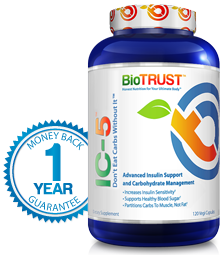
And that’s exactly what the key ingredients in IC-5™ have been scientifically proven to do.
You see, as mentioned, IC-5™ is a synergistic blend of 5 unique, hard-to-come-by ingredients that have been clinically proven to increase insulin sensitivity and blood sugar management.
- For instance, the first ingredient in IC-5™ is Cinnamomum Burmannii,
a potent extract harvested from Indonesian cinnamon bark that has been
shown to effectively assist in managing blood sugar after a
carbohydrate-rich meal while increasing glucose metabolism by up to 10 fold.1-3
- The second ingredient is a rare plant alkaloid called Berberine
that has been used for centuries in Ayurvedic medicine by healers in
India. Berberine works slightly differently, by improving the signaling
between insulin and its associated receptors while also increasing glucose uptake by skeletal muscle, not fat.4-7
- IC-5’s third ingredient, Pterocarpus Marsupium, is
actually one of the drugs used in the treatment of diabetes by Ayurvedic
physicians in India. In fact, Pterocarpus Marsupium is so effective
that it was shown in a recent research study to reduce blood sugar
levels 2 hours after a meal by a whopping 21%.8-12
- One of the most unique, exotic ingredients in IC-5™ is 4-hydroxyisoleucine, a natural phytochemical extracted from the Fenugreek herb that has been scientifically shown to increase glycogen storage while decreasing fat storage through the sensitizing of insulin receptors in muscle tissue.13
4-hydroxyisoleucine can also inhibit some of the absorption of
sugars and starchy carbohydrates through the intestine into the blood
stream.14 This helps decrease the glycemic response to carbohydrate meals, helping keep blood sugar balanced.
- Lastly, the ground-breaking IC-5™ formula is completed by R-Alpha-Lipoic-Acid or simply R-ALA. Alpha Lipoic Acid is made up of two isomers, S-ALA and R-ALA, of which the R isomer has been shown to be significantly more effective and bioavailable.15 Naturally, for that reason we’ve included the R isomer in the IC-5™ formula, a compound that has been clinically shown to increase insulin sensitivity by an impressive 25%
in just 4 weeks while increasing the presence of glucose transporters
in cell membranes to aid in the rapid clearance of glucose from the
blood stream.16
In fact, ALA is so potent that in Germany it’s approved for the
treatment of diabetic neuropathies and is available by prescription
only.
Simply put, IC-5™ is the most advanced formula of its kind, and it’s only available from BioTrust™ right here on this website.
If you’re eating carbs, and you should be, you should be using IC-5™.
And just like all of our products, with IC-5™ you’re protected by our
Unconditional 1 year, 100% Satisfaction Money-Back Guarantee, so
there’s nothing to lose, and benefiting from IC-5™ couldn’t be easier.
Just take 2 capsules with any carb-containing meal and let science do
the rest.
To begin experiencing just how easy insulin sensitivity and blood
sugar management can be with the key ingredients in IC-5™, simply choose
your money-saving package below the video image on this page and then
click Add to Cart. IC-5™: Don’t eat carbs without it.
References
- Anderson RA, Broadhurst CL, Polansky MM, Schmidt WF, Khan A,
Flanagan VP, Schoene NW, Graves DJ. Isolation and characterization of
polyphenol type-A polymers from cinnamon with insulin-like biological
activity. J Agric Food Chem. 2004 Jan 14;52(1):65-70.
- Jarvill-Taylor KJ, Anderson RA, Graves DJ. A hydroxychalcone
derived from cinnamon functions as a mimetic for insulin in 3T3-L1
adipocytes. J Am Coll Nutr. 2001 Aug;20(4):327-36.
- Hlebowicz J, Darwiche G, Bjorgell O and Almer LO. Effect of
cinnamon on postprandial blood glucose, gastric emptying, and satiety in
healthy subjects. Am J Clin Nutr 2007; 85: 1552-1556.
- Rayasam GV, et al. Identification of berberine as a novel agonist
of fatty acid receptor GPR40. Phytother Res. 2010 Aug;24(8):1260-3.
- Zhang H, Wei J, Xue R, Wu JD, Zhao W, Wang ZZ, Wang SK, Zhou ZX,
Song DQ, Wang YM, Pan HN, Kong WJ, Jiang JD. Berberine lowers blood
glucose in type 2 diabetes mellitus patients through increasing insulin
receptor expression. Metabolism. 2010 Feb;59(2):285-92.
- Kong WJ, Zhang H, Song DQ, Xue R, Zhao W, Wei J, Wang YM, Shan N,
Zhou ZX, Yang P, You XF, Li ZR, Si SY, Zhao LX, Pan HN, Jiang JD.
Berberine reduces insulin resistance through protein kinase C-dependent
up-regulation of insulin receptor expression. Metabolism. 2009
Jan;58(1):109-19.
- Jun Yina,b,*, Huili Xinga, and Jianping Yeb. Efficacy of Berberine
in Patients with Type 2 Diabetes. Metabolism. 2008 May ; 57(5): 712–717.
- Sawhney, P.L. and Seshadri, T.R. 1956. Special chemical components
of commercial woods and related plant materials: Part IV - Phenolic
components of some Pterocarpus species. Journal of Science in India,
Res. 15C, 154.
- Dravya Gund Vigyan (Baidyanath Prakashan); Gaon Ki Aushadhi Ratna (Kalida) Part I and II, Bhavprakash Nighantu.
- Dharmadhikari, S.D., Patki, V.P. and Dashputra, P.O. 1984. Study of
mechanism of hypoglycaemia due to Pterocarpus marsupium. Abstr of paper
presenled of XVIth Ann Conf.. Indian Pharmacol Soc., Ajmer, Dec. 28-30,
1983. Indian J Pharmacol 16, 61.
- Ahmad F, Khan MM, Rastogi AK, Chaubey M, Kidwai JR. Effect of
(-)epicatechin on cAMP content, insulin release and conversion of
proinsulin to insulin in immature and mature rat islets in vitro. Indian
J Exp Biol. 1991 Jun;29(6):516-20.
- Indian Council of Medical Research (ICMR), Collaborating Centres,
New Delhi. Flexible dose open trial of Vijayasar (Pterocarpus marsupium)
in cases of newly-diagnosed non-insulin-dependent diabetes mellitus.
Indian J Med Res 1998 Nov;108:253
- Ruby BC, Gaskill SE, Slivka D, Harger SG. The addition of fenugreek
extract (Trigonella foenum-graecum) to glucose feeding increases muscle
glycogen resynthesis after exercise. Amino Acids. 2005 Feb;28(1):71-6.
Epub 2004 Dec 2.
- Hannan JM, Ali L, Rokeya B, Khaleque J, Akhter M, Flatt PR,
Abdel-Wahab YH. Soluble dietary fibre fraction of Trigonella
foenum-graecum (fenugreek) seed improves glucose homeostasis in animal
models of type 1 and type 2 diabetes by delaying carbohydrate digestion
and absorption, and enhancing insulin action. Br J Nutr. 2007
Mar;97(3):514-21.
- Hermann R, Niebch G, Borbe HO, et al. Enantioselective
pharmacokinetics and bioavailability of different racemic alpha-lipoic
acid formulations in healthy volunteers. Eur J Pharm Sci.
1996;4:167-174.
- Jacob S, Rett K, Henriksen EJ, Haring HU. Thioctic acid--effects on
insulin sensitivity and glucose-metabolism. Biofactors.
1999;10(2-3):169-174.


